
For dedicated League of Legends players across the Middle East, the once-reliable low-latency connections to regional servers have become a distant memory. What was previously a crisp 15-20 ms experience for summoners in the UAE, Saudi Arabia, Qatar, Oman, and Kuwait has, for many, devolved into a frustrating battle against 130-160 ms ping. This dramatic shift has transformed the Summoner's Rift into a lag-ridden nightmare, severely impacting competitive play and casual enjoyment alike. This article will dissect the complex reasons behind the League of Legends server connection issues in the Middle East, offering a clear understanding of the problem and a robust, professional solution to help you reclaim your competitive edge.

- ✅ Reduce Lag and High Ping.
- ✅ Boost FPS at the Same Time.
- ✅ Support 8000+ Online Games
- ✅ Change Server Without Latency.
- ✅ Multiplatform: PC, Console, Mobile.
Part 1. What is the State of the ME (Middle East) Server in 2026?
Part 2. League of Legends High Ping in Middle East: The Data Behind the Lag
Part 3. Why Traditional Fixes Like DNS and VPNs Fail for LoL Players
Part 4. Regional Challenges: From Kuwait’s Power Grid to Oman’s Cable Diversity
Part 5. How to Fix League of Legends Server Connection Issues
Part 6. How to Enhance Your Game Experience with LagoFast Game Booster
Part 1. What is the State of the ME (Middle East) Server in 2026?
The abrupt and widespread increase in latency for League of Legends players in the Middle East is not a random occurrence; it stems from significant infrastructure challenges that have impacted the region in early 2026. Historically, Riot Games provided dedicated MENA (Middle East and North Africa) servers, often hosted on AWS infrastructure in locations like Bahrain and Dubai, offering optimal low-latency connections to local players.
However, in March 2026, reports emerged of critical infrastructure damage to AWS Bahrain (ME-SOUTH-1) and AWS UAE (ME-CENTRAL-1) data centers. These incidents, attributed to regional conflicts, caused structural damage and power delivery disruptions. Given that Riot Games ran League of Legends' MENA servers on this shared infrastructure, the damage forced these regional servers offline.
Consequently, players who were once connected to nearby servers are now being involuntarily rerouted to European hubs, primarily Frankfurt (EUW) or Amsterdam (EUNE). This rerouting, often referred to as the "Frankfurt Reroute," adds thousands of kilometers of physical distance between your PC and the game server. Instead of a 600-kilometer journey across the Gulf, your data packets must now travel 4,000 to 5,000 kilometers through international submarine cables, resulting in the massive ping jump observed by players across the region.
Part 2. League of Legends High Ping in Middle East: The Data Behind the Lag
The impact of these infrastructure failures is not uniform across the Middle East, but the trend is undeniably negative. For a MOBA like League of Legends, where animation cancels and frame-perfect flashes are the difference between a won team fight and a lost objective, these numbers represent a catastrophic shift in gameplay quality.
The following table summarizes the real-world latency data reported by players in 2026 across major Middle Eastern cities. These figures represent the typical experience without professional network optimization:
|
Country |
City |
Typical Ping (Without Optimization) |
|
UAE |
Dubai |
80–100ms |
|
Abu Dhabi |
80–100ms |
|
|
Saudi Arabia |
Riyadh |
80–130 ms |
|
Jeddah |
90–130ms |
|
|
Qatar |
Doha |
70–130 ms |
|
Lusail |
70–125ms |
|
|
Oman |
Muscat |
60–110ms |
|
Salalah |
65–110 ms |
|
|
Kuwait |
Kuwait City |
90–130ms |
|
Salmiya |
90–125ms |
This data highlights a harsh reality: players in Qatar and Kuwait are currently facing the worst proportional loss in the region, with pings frequently spiking above 130ms. Meanwhile, Oman’s unique geography and submarine cable diversity in Muscat and Salalah offer a slight advantage, though still far from the competitive 20ms players once enjoyed.
Part 3. Why Traditional Fixes Like DNS and VPNs Fail for LoL Players
When faced with 150 ms ping, the first instinct for many summoners is to change their DNS settings to Google (8.8.8.8) or Cloudflare (1.1.1.1), or to fire up a generic VPN. However, these methods are often ineffective for League of Legends.
DNS changes only speed up the initial "address lookup" of the server; they do not change the physical path your game packets take once the match starts. Generic VPNs, designed for privacy and encryption, often add even more latency due to encryption overhead. Furthermore, they typically use single-path routing. If that one path through the Red Sea or Mediterranean is congested, your game will experience massive jitter and packet loss.
In a MOBA, jitter—the variation in your ping—is often more lethal than the raw ping number itself. League of Legends processes game states roughly 30 times per second. If your ping bounces between 100ms and 140ms, your last-hitting rhythm becomes impossible to internalize, and your skillshots will consistently land behind where the enemy actually is.
Part 4. Regional Challenges: From Kuwait’s Power Grid to Oman’s Cable Diversity
Beyond the primary server crisis, local factors in specific countries compound the connection issues. In Kuwait, for instance, players face a dual threat: high ping and power grid instability. Recent damage to transmission lines has led to micro-brownouts—brief voltage drops that can flicker an internet connection for less than a second. At 20ms, this might be a minor stutter; at 130ms to Europe, it often triggers a full disconnect, leading to LeaverBuster penalties and lost LP.
Conversely, Oman sits at a strategic crossroads. Its coastline faces the Arabian Sea, serving as a landing point for multiple international cables like the Blue-Raman and India Europe Xpress (IEX). This diversity means there are more physical paths to optimize. Furthermore, if Riot eventually utilizes AWS infrastructure in Mumbai, Omani players would be the first to benefit from significantly lower pings due to their proximity to the Indian subcontinent.
Part 5. How to Fix League of Legends Server Connection Issues
Before turning to professional software, ensure your local setup is optimized. Always use a wired Ethernet connection; Wi-Fi in dense urban areas like Dubai or Riyadh is prone to interference that adds unnecessary jitter. Ensure background applications like Chrome or Windows Update aren't hogging your bandwidth, and keep your router in a well-ventilated area to prevent thermal throttling.
However, these local fixes cannot overcome the 5,000-kilometer physical distance to Europe. To truly solve the League of Legends server connection issues in the Middle East, you need a tool such as LagoFast Game Booster that can optimize the international routing layer
Part 6. How to Enhance Your Game Experience with LagoFast Game Booster
LagoFast (LagoFast Game Booster - Get No Lag and Lower Ping) Game Booster is designed specifically to bridge the gap between Middle Eastern ISPs and global game servers. Unlike a standard VPN, LagoFast uses a proprietary protocol and a global network of dedicated gaming nodes to find the shortest, most stable path for your data.
LagoFast’s "Multipath" technology is particularly effective for the current MENA crisis. It sends your game data across multiple network paths simultaneously. If one submarine cable experiences a micro-spike or congestion, the secondary path delivers the packet on time. This stabilizes your jitter and keeps your connection rock-solid, even during peak evening hours.
How to Use LagoFast Game Booster
Step 1: Click the Free Trial button to download and install LagoFast Free Trial.
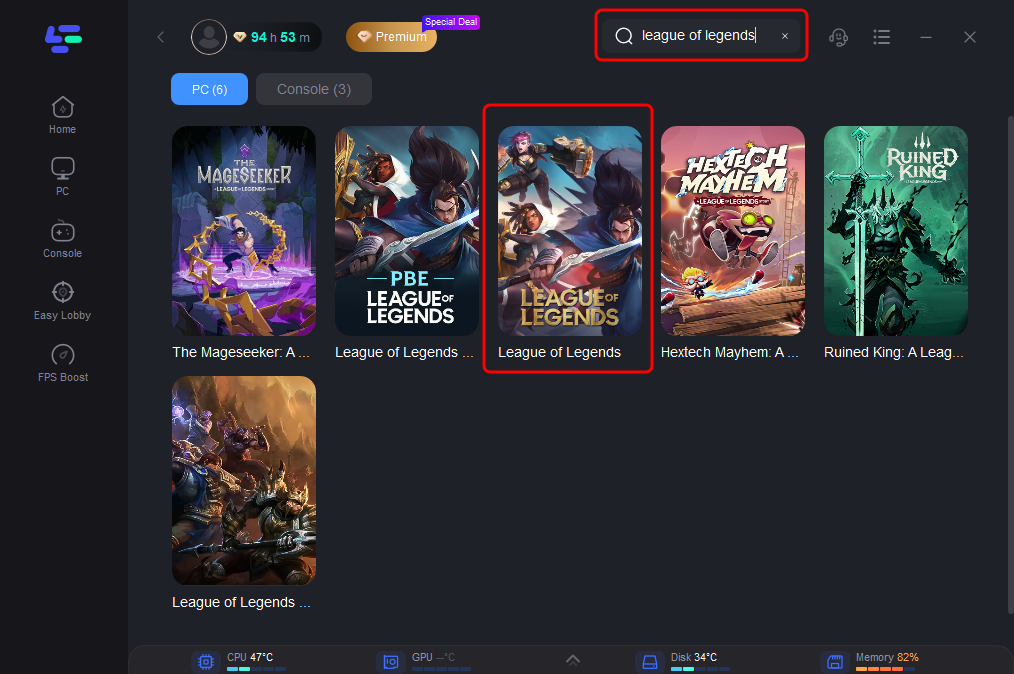
Step 2: Search for League of Legends: Open the app and type "League of Legends" in the search bar.
Step 3: Select Your Region: Choose the server you play on (e.g., EU West or EU Nordic & East).
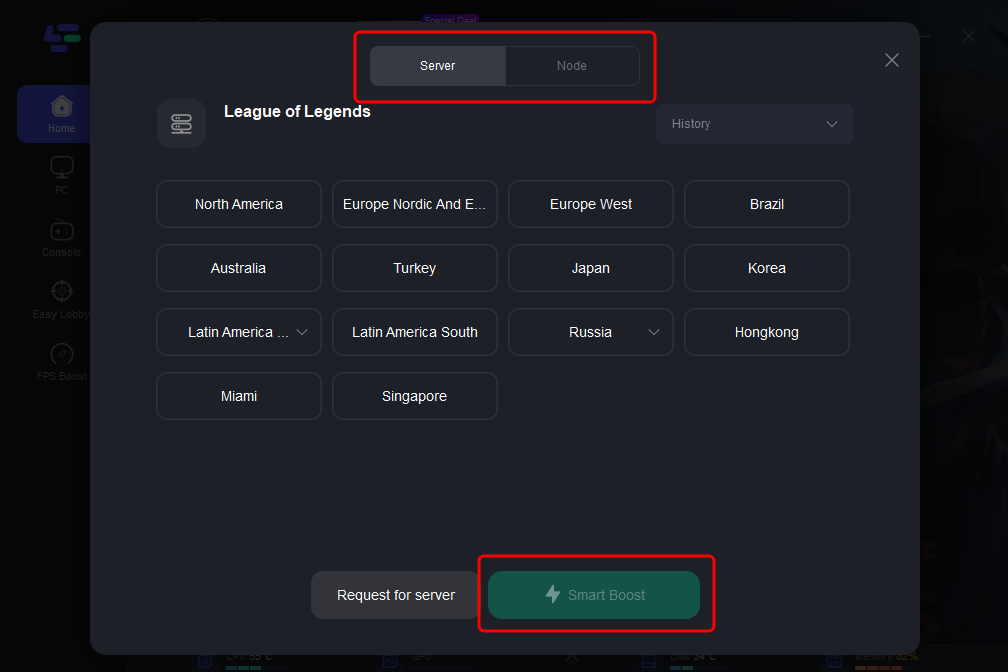
Step 4: Choose the Optimal Node: LagoFast will display a list of nodes. For Middle Eastern players, the "Smart" selection will automatically find the best route to Europe, bypassing congested regional hops.
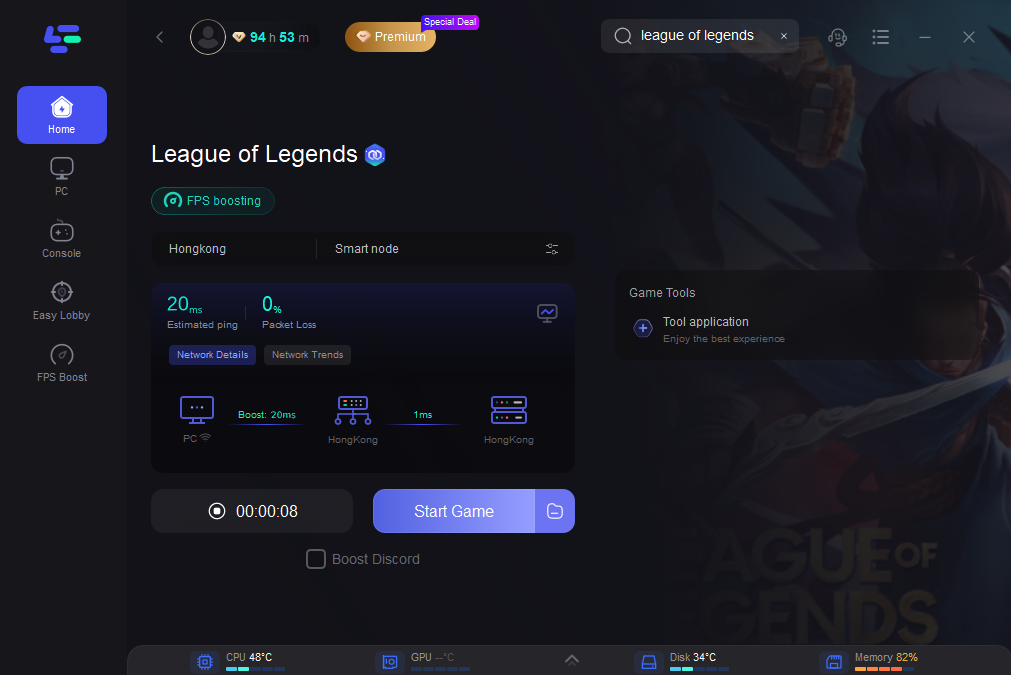
Step 5: One-Click Boost: Click the "Boost" button. You will see your real-time ping and packet loss drop significantly.
Part 7. FAQs
Q: Why did my ping go from 20ms to 160ms overnight?
A: This is due to the 2026 infrastructure damage to AWS data centers in Bahrain and Dubai. Riot's MENA servers are currently offline, forcing your connection to route to distant European servers.
Q: Is the MENA server coming back?
A: Riot has acknowledged the routing issues, but restoration depends on the physical repair of regional data centers. Until then, routing optimization is the only way to maintain competitive play.
Q: Can I get banned for using a game booster?
A: No. LagoFast operates at the network routing level and does not modify game files. It is fully compatible with Riot Vanguard and carries zero ban risk.
Conclusion
The current state of League of Legends in the Middle East is a test of patience for every summoner. Between regional infrastructure damage and the inherent challenges of intercontinental routing, the "Frankfurt Reroute" has made competitive play nearly impossible for many. However, by understanding the technical causes—from AWS disruptions to the sensitivity of MOBA netcode—you can take steps to mitigate the damage. LagoFast Game Booster provides the necessary stability and route optimization to transform a jittery 150ms mess into a stable, competitive connection. Don't let infrastructure failures stall your climb; download LagoFast today and get back to winning your lane.

Boost Your Game with LagoFast for Epic Speed
Play harder, faster. LagoFast game booster eliminates stutter and lags on PC, mobile, or Mac—win every match!
Quickly Reduce Game Lag and Ping!
Boost FPS for Smoother Gameplay!